Explore SZBL

Institute of Chemical Biology
liliniu(at)szbl.ac.cn
Biochemistry, Bioinformatics, Proteomics
Junior Principal Investigator
Senior Research Scientist
Postdoc
PhD
Master
Bachelor
We aim to develop and optimize mass spectrometry-based proteomics workflows to achieve high-throughput, deep-coverage, and highly reproducible quantitative analysis of clinical samples. Leveraging this technological foundation, we will characterize human proteome variation and investigate its determinants. This involves constructing comprehensive reference maps with absolute quantification of the human proteome in both health and disease by analyzing large-scale cohorts of general and diseased populations. A key focus will be elucidating the impact of genetic variation on protein abundance and function, with insights applied to target discovery. Finally, we will discover and validate protein biomarkers for early disease screening, prognostic assessment, and population stratification.
Lili Niu, Junior Principal Investigator, recipient of the “Excellent Young Scientists Fund (Overseas)”
Dr. Lili Niu was mentored by Professor Matthias Mann, a leading figure in the field of proteomics and a member of multiple national academies (Germany's most highly cited researcher, H-index 277). Her research focuses on the application of proteomics in biomarker and mechanistic studies of liver diseases. She has systematically revealed novel plasma protein changes associated with chronic liver disease. Through a clinical proteomics study involving over 600 patients, she developed a minimally invasive diagnostic model for alcohol-related liver disease, enabling early identification and risk prediction based on plasma proteomics. The performance of this model is superior or comparable to several existing clinical diagnostic methods.
During her postdoctoral fellowship, she collaborated with Professor Simon Rasmussen's team and expanded her research to genome-wide association studies of protein expression levels, achieving cross-omics integration. By analyzing the plasma proteome and genotypes of more than 3,000 Danish children and adolescents, she systematically characterized the age-, sex-, puberty-, and obesity-dependent patterns, as well as the genetic regulation of over a thousand plasma proteins. This work fills a gap in the study of protein genetic regulation during pediatric development and provides new molecular insights into the physiological changes of puberty. It also identified potential causal targets for various cardiometabolic diseases.
Her research outcomes have been simultaneously integrated into interactive data platforms for researchers to freely explore:
Liverproteome.org
Pqtl.org
Dr. Niu has authored or co-authored more than 20 academic papers, including first or corresponding author publications in journals such as Nature Medicine, Nature Genetics, and Molecular Systems Biology (x2). Her work has been cited by high-impact journals such as Nature and Cell. She has received honors including the Chinese Human Proteome Organization (CNHUPO) π-Hub "Rising Star Award" (2023). She currently serves as a reviewer for journals such as Nature Medicine and Nature Communications.
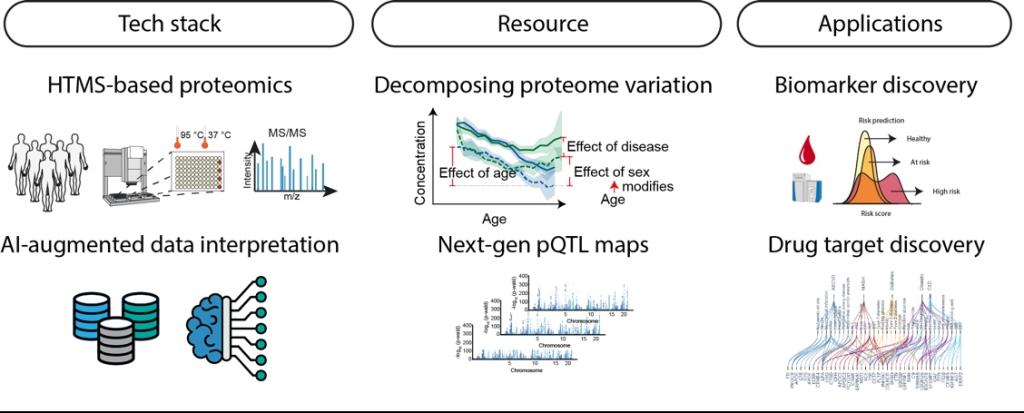
Figure 1 illustrates the research focus of Lili Niu’s lab encompassing three major directions: development of proteomics workflows that enable comprehensive and high-throughput profiling of clinical samples; generation of high-quality, next-generation human proteome maps with translational value; and application research focusing on early disease diagnosis, prognosis assessment, treatment response evaluation, and the discovery of potential new drug targets.
1.Lili Niu#; Sara Elizabeth Stinson; Louise Aas Holm; Morten Asp Vonsild Lund; Cilius Esmann Fonvig; Leonardo Cobuccio; Jonas Meisner; Helene Bæk Juel; Joao Fadista; Maja Thiele; Aleksander Krag; Jens-Christian Holm; Simon Rasmussen*; Torben Hansen*; Matthias Mann*; Plasma proteome variation and its genetic determinants in children and adolescents, Nature Genetics, 2025, 57:635-646
2.Lili Niu#; Maja Thiele; Philipp E Geyer; Ditlev Nytoft Rasmussen; Henry Emanuel Webel; Alberto Santos; Rajat Gupta; Florian Meier; Maximilian T. Strauss; Maria Kjærgaard; Katrine Lindvig; Suganya Jacobsen; Simon Rasmussen; Torben Hansen; Aleksander Krag; Matthias Mann*; Noninvasive proteomic biomarkers for alcohol-related liver disease, Nature Medicine, 2022, 28(6):1277-1287
3.Lili Niu#; Philipp E Geyer; Rajat Gupta; Alberto Santos; Florian Meier; Sophia Doll; Nicolai J. Wewer Albrechtsen; Sabine Klein; Cristina Ortiz; Frank E Uschner; Robert Schierwagen; Jonel Trebicka*; Matthias Mann*; Dynamic human liver proteome atlas reveals functional insightsinto disease pathways, Molecular Systems Biology, 2022, 18(5):e10947
4.Lili Niu#*; Karolina Sulek; Catherine G. Vasilopoulou; Alberto Santos; Nicolai J. Wewer Albrechtsen; Simon Rasmussen; Florian Meier; Matthias Mann; Defining NASH from a Multi-OmicsSystems Biology Perspective, Journal of Clinical Medicine, 2021, 10(20): 4673
5.Lili Niu#; Philipp E. Geyer#; Nicolai J. Wewer Albrechtsen; Lise Lotte Gluud; Alberto Santos; Matthias Mann; Peter V. Treit; Jens J. Holst; Filip K. Knop; Tina Vilsbøll; Anders Ellekær Junker; Stephan Sachs; Kerstin Stemmer; Timo D. Müller; Matthias H. Tschöp; Susanna M. Hofmann; Matthias Mann*; Plasma proteome profiling discovers novel proteins associated with nonalcoholicfatty liver disease., Molecular Systems Biology, 2019, 15(3): e8793-e8793
6.Lili Niu#; Matthias Mann*; Quick and clean: Cracking sentences encoded in E. coli by LC–MS/MS, de novo sequencing, and dictionary search, EuPA Open Proteomics, 2019, 22-23: 30-35
7.Henry Webel#;Lili Niu; Annelaura Bach Nielsen; Marie Locard-Paulet; Matthias Mann; Lars Juhl Jensen; Simon Rasmussen*; Imputation of label-free quantitative mass spectrometry-basedproteomics data using self-supervised deep learning, Nature Communications, 2024, 15(1)
8.Alberto Santos#;Ana R. Colaço; Annelaura B. Nielsen;Lili Niu; Maximilian Strauss; Philipp E. Geyer; Fabian Coscia; Nicolai J. Wewer Albrechtsen; Filip Mundt; Lars Juhl Jensen; Matthias Mann*; A knowledge graph to interpret clinical proteomics data, Nature Biotechnology,2022, 40: 692-702
9.Thiele M#, Villesen IF,Niu L, Johansen S, Sulek K, Nishijima S, Espen LV, Keller M, Israelsen M, Suvitaival T, Zawadzki A, Juel HB, Brol MJ, Stinson SE, Huang Y, Silva MCA, Kuhn M, Anastasiadou E, Leeming DJ, Karsdal M, Matthijnssens J, Arumugam M, Dalgaard LT, Legido-Quigley C, Mann M, Trebicka J, Bork P, Jensen LJ, Hansen T, Krag A*; MicrobLiver consortium; GALAXY consortium. Opportunities and barriers in omics-based biomarker discovery for steatotic liver diseases. J Hepatol. 2024 Aug;81(2):345-359. doi:
10.1016/j.jhep.2024.03.035.
Contact
Address: Gaoke Innovation Center,Guangming District, Shenzhen
Phone: +86-755-86967710
Email: webmaster@szbl.ac.cn
Postal Code: 518132
Copyright © 2025 Shenzhen Bay Laboratory. All Rights Reserved.