Explore SZBL


Institute of Infectious Diseases
qiankun.wang(at)szbl.ac.cn
Virology,Microbiology,Immunology
Junior Principal Investigator
Postdoc & Instructor
PhD
MS
Our specific interests include:
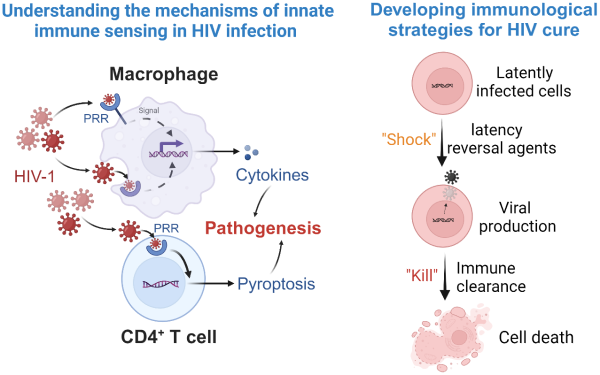
1) Molecular mechanisms of HIV pathogenesis;
2) Novel immunological strategies to eliminate HIV reservoirs;
3) Functional genetic study of HIV-host interactions in humanized mice.
Qiankun Wang obtained his Ph.D. from Wuhan University, focusing on the HIV/AIDS gene therapy. He next conducted postdoctoral training at Washington University School of Medicine, where he studied the role of inflammasome in HIV pathogenesis and cure using the humanized mouse model. He joined the Shenzhen Bay laboratory as a Principal Investigator in 2024.
Qiankun Wang's major research areas and discoveries are as follows:
1. Molecular mechanisms of HIV pathogenesis
CD4+ T cell loss during chronic HIV-1 infection is a hallmark of AIDS progression. The underlying mechanism of CD4+ T cell depletion during HIV-1 infection is not well understood. We recently identified that the CARD8 inflammasome drives bystander CD4+ T cell depletion and disease progression by rapidly sensing HIV particles. Furthermore, we discovered the loss-of-function mutations in CARD8 from African small non-human primates, which may explain the peculiarly non-pathogenic nature of SIV infections.
2. Novel immunological strategies to eliminate HIV-infected cells
HIV-1 latent reservoir is the major barrier to an HIV cure. We recently reported that targeting CARD8 inflammasome may be a promising strategy to eliminate residual HIV-1-infected cells. We found premature activation of intracellular HIV-1 protease by non-nucleoside reverse transcriptase inhibitor (NNRTI) triggers CARD8 sensing and pyroptosis of HIV-infected macrophages and CD4+ T cells.
1.Wang Q, Clark KM, Tiwari R, Raju N, Tharp GK, Rogers J, Harris RA, Raveendran M, Bosinger SE, Burdo TH, Silvestri G, Shan L. The CARD8 inflammasome dictates HIV/SIV pathogenesis and disease progression.Cell. 2024 Feb 29;187(5):1223-1237.e16.
2.Wang Q, Gao H, Clark KM, Mugisha CS, Davis K, Tang JP, Harlan GH, DeSelm CJ, Presti RM, Kutluay SB, Shan L. CARD8 is an inflammasome sensor for HIV-1 protease activity.Science. 2021 Mar 19;371(6535):eabe1707.
3. Sungur CM,Wang Q, Ozantürk AN, Gao H, Schmitz AJ, Cella M, Yokoyama WM, Shan L. Human NK cells confer protection against HIV-1 infection in humanized mice.J Clin Invest. 2022 Dec 15;132(24):e162694.
4.Wang Q, Shan L. CARD8 makes coxsackievirus more "heartbreaking".J Exp Med. 2022 Oct 3;219(10):e20221240.
5.Wang Q, Shan L. Inflammasomes in Human Immunodeficiency Virus Type 1 Infection.Infectious Diseases & Immunity. 2022 Oct 20;2(04):248-52.
6.Wang Q, Chen S, Xiao Q, Liu Z, Liu S, Hou P, Zhou L, Hou W, Ho W, Li C, Wu L, Guo D. Genome modification of CXCR4 by Staphylococcus aureus Cas9 renders cells resistance to HIV-1 infection.Retrovirology. 2017 Nov 15;14(1):51.
7.Wang Q, Liu S, Liu Z, Ke Z, Li C, Yu X, Chen S, Guo D. Genome-scale screening identification of SaCas9/gRNAs for targeting HIV-1 provirus and suppression of HIV-1 infection.Virus Res. 2018 May 2;250:21-30.
Contact
Address: Gaoke Innovation Center,Guangming District, Shenzhen
Phone: +86-755-86967710
Email: webmaster@szbl.ac.cn
Postal Code: 518132
Copyright © 2025 Shenzhen Bay Laboratory. All Rights Reserved.