Explore SZBL

Institute of Chemical Biology
geyun(at)szbl.ac.cn
Chemical Biology, Glycobiology
Junior Principal Investigator
Postdoctoral Fellow
Ph.D. in Chemical Biology
B.Sc. in Chemistry
Glycan code is fundamental to molecular interactions and information flow in living systems. However, unlike the genome and proteome, the glycome still represents an uncharted frontier. Focusing on glycan interactions and modifications, our lab aims to build a profile–edit–engineer paradigm across the glycan–protein and glycan–RNA axes to achieve programmable control across scales and convert mechanistic and functional understanding into controllable and deployable solutions for the regulation of cellular activities and disease.
Our research interests lie in three directions:
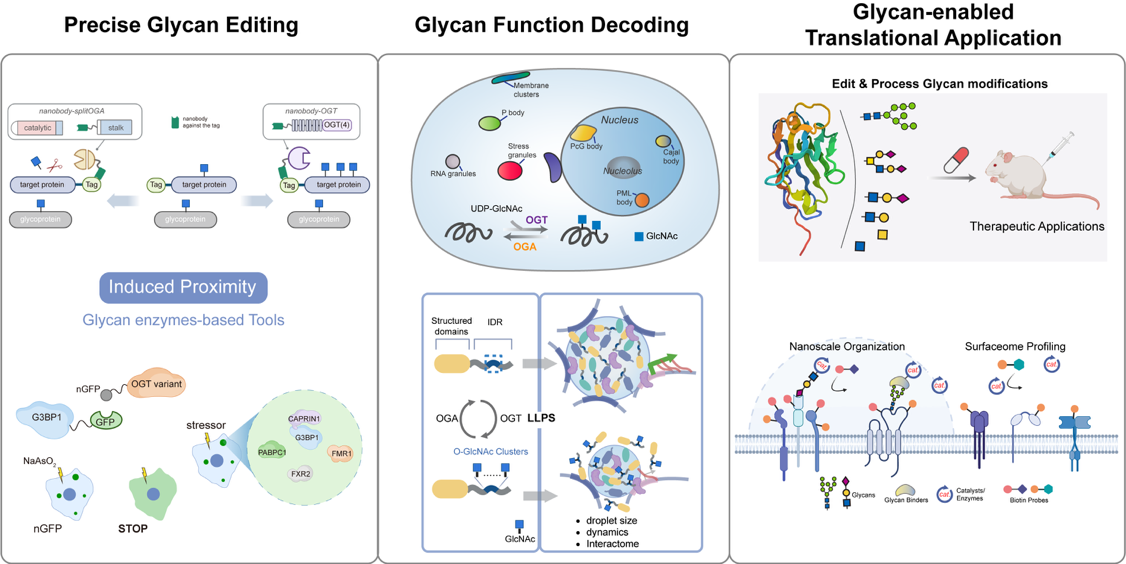
(1)PreciseGlycan Editing:Along the glycan–protein and glycan–RNA axes, we develop spatiotemporally resolved, substrate-selective glycan-editing and interface-rewiring tools to enable precise interventions in defined cellular contexts.
(2)In-depth Glycan Function Decoding:Using an interdisciplinary chemical biology toolkit, we interrogate the crosstalk between glycans and proteins/RNA, emphasizing space- and state-specific functions—e.g., at the cell surface and within biomolecular condensates—and link condensates and transcription/translation programs.
(3)Glycan-Enabled Translational Applications:We uncover glycan-coassembled functional microenvironments and design systematic profiling and intervention strategies for diagnosis and therapy—including glycan editing to boost cancer immunotherapy, discovery of new cell-surface markers and glycan-mediated interactions, and glycan-empowered biodrugs.
Yun Ge is a junior PI at the Institute of Chemical Biology, Shenzhen Bay Laboratory, and an assistant professorat Peking University Shenzhen Graduate School. She is a recipient of the National Natural Science Foundation of China Excellent Young Scientists Fund (Overseas)and several other national grants. Dr. Ge received her B.S. from Xiamen University in 2013 and her Ph.D. from Peking University in 2018, followed by postdoctoral training in the Department of Chemistry and Chemical Biology at Harvard University. She joined SZBL in 2022 to establish her independent laboratory.
The Ge Lab focuses on the chemical biology of glycan interaction and editing. Current efforts center on (i) profiling glycosylation and developing precision glycan-editing tools, (ii) uncovering the unique roles of glycosylation across diverse biological systems, and (iii) empowering functional biomolecules with glycan modifications for therapeutic applications.
As first or corresponding author, Dr. Ge has published in Nature Cell Biology, Nature Chemical Biology, Nature Communications, Journal of the American Chemical Society, and Angewandte Chemie etc.. She holds several international and domestic patents and was invited by Cell on its 50th anniversary to comment on future directions in glycobiology. Major achievements in the Ge lab include: developing the first protein-selective “eraser” of glycosylation for precise functional dissection; establishing regulatory principles of glycosylation in biomolecular condensates and creating tools to modulate processes such as stress-granule dynamics; building a nanobody glycoengineering platform to enable glycan-based cancer immunotherapy strategies; and establishing systematic surfaceome profiling and intervention technologies for cell-membrane proteins.
[1] N. Wang, F. Hou, S. Ma, S. Liu, H. Wei, W. Fang, K. Zhang, Y. Ge*,“Targeted stress granule regulation by engineering a non-catalytic O-GlcNAc transferase”Nat. Commun. 2025, in press.
[2] S. Sun, S. Liu, T. Deng, Y. Hu, R. Yang, J. P. Li*, Y. Ge*, “Cocktail Chemical Labeling for In-Depth Surfaceome Profiling of Bone-Marrow-Derived Dendritic Cells”Anal. Chem. 2025, acs. analchem. 5c02734.
[3] J. Wu#, H. Lu#, X. Xu, L. Rao*,Y. Ge*, “Engineered Cellular Vesicles Displaying Glycosylated Nanobodies for Cancer Immunotherapy”Angew. Chem. Int. Ed. 2024, 63, e202404889.
[4] Peter H. Seeberger, Yun Ge, Christine M. Szymanski, Daniel Kolarich, Morten Thaysen-Andersen, Nicolle H. Packer, Elisa Fadda, Benjamin Davis, Shoko Nishihara, Gabriel A. Rabinovich, Peter D. Kwong, Richard Strasser, “What comes next in glycobiology” Cell 2024, 187, 2628–2632.
[5] Y. Liu#, Y. Ge#, R. Zeng#, W. S. C. Ngai, X. Fan, P. R. Chen*, “Proximity Chemistry in Living Systems”CCS Chem. 2023, 5, 802–813.
[6] Y. Chen#, R. Wan#, Z. Zou#, L. Lao, G. Shao, Y. Zheng, L. Tang, Y. Yuan,Y. Ge*, C. He*, S. Lin*, “O-GlcNAcylation determines the translational regulation and phase separation of YTHDF proteins”Nat. Cell Biol. 2023, 25, 1676–1690.
[7] Y. Ge, D. H. Ramirez, B. Yang, A. K. D’Souza, C. Aonbangkhen, S. Wong, C. M. Woo*, “Target protein deglycosylation in living cells by a nanobody-fused split O-GlcNAcase”Nat. Chem. Biol. 2021, 17, 593–600.
[8] Y. Ge#, L. Chen#, S. Liu, J. Zhao, H. Zhang, P. R. Chen*, “Enzyme-Mediated Intercellular Proximity Labeling for Detecting Cell–Cell Interactions”J. Am. Chem. Soc. 2019, 141, 1833–1837.
Contact
Address: Gaoke Innovation Center,Guangming District, Shenzhen
Phone: +86-755-86967710
Email: webmaster@szbl.ac.cn
Postal Code: 518132
Copyright © 2025 Shenzhen Bay Laboratory. All Rights Reserved.