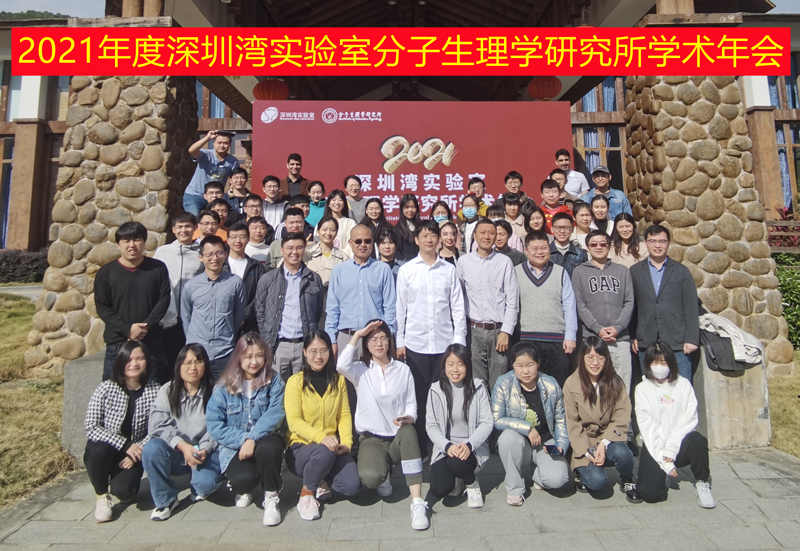
On December 29~30, 2021, the 2021 annual conference was successfully held at the Institute of Molecular Physiology, Shenzhen Bay Laboratory with the attendance of about 80 research team leaders and experts. The principal investigators, Deng Lin, Cai Yuxuan and Liang Zhuobin, presided over the conference. Professor Rao Yi, the organizer of the Institute of Molecular Physiology, delivered an opening speech online, and then the research team leaders made the annual reports in the online and offline manner.
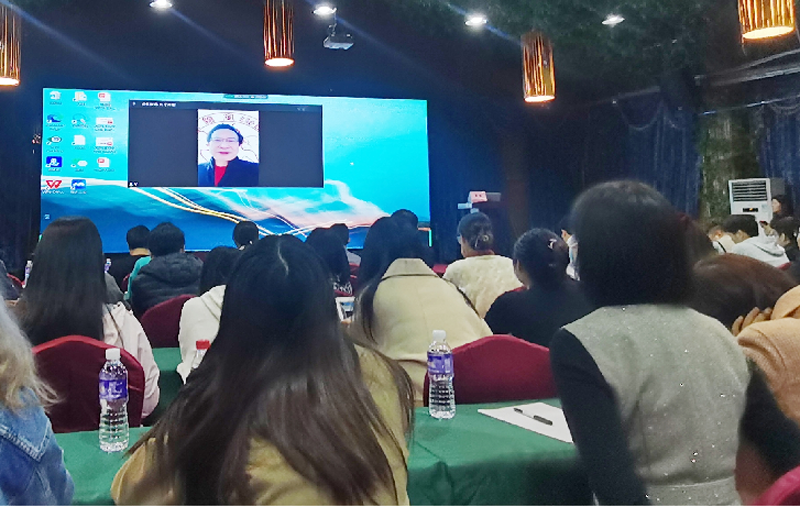
The conference officially kicked off on the afternoon of December 29th. Prof. Rao Yi, the organizer of the Institute of Molecular Physiology, expressed his gratitude to all the participants in his opening speech online. He recalled that a total of 14 core scientific research teams with more than 100 scientific research fellows had been established in the Institute, and significant progress had been made in terms of scientific research output and talent building. He said that the initial construction and academic leading role of the cooperating research fellows had played an important role in the past year. He hoped that the full-time research fellows could give full play to the leading role and cooperate with the cooperating research fellows to fully promote the development of the Institute of Molecular Physiology and the laboratory. He pointed out that the Institute of Molecular Physiology focused on the research of molecular biology and physiology, the two directions with the same importance, and we should continue to carry out the scientific research in the direction of molecular biology and physiology. He also stressed that talent was the key factor to promote the scientific researches and we should focus on the building of research teams. In the end, Prof. Rao Yi hoped that the talent building and scientific research could be carried out at the same time, so as to lay solid foundation for the long-term development of the Laboratory.
After that, the leaders of the research teams introduced the scientific research progress and the team building achieved in 2021 as well as the follow-up research plans in detail respectively.
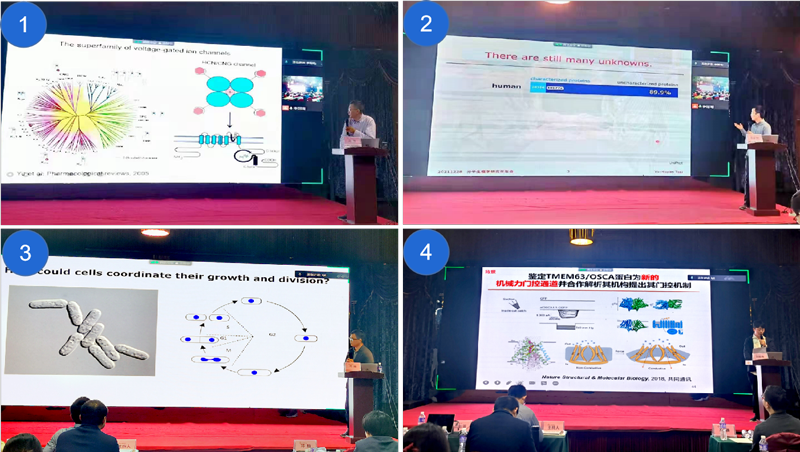
Figures 1~4 Reports by Zhou Lei's Research Team, Cai Yuxuan's Research Team, Deng Lin's Research Team and Yan Zhiqiang's Research Team
Senior Principal Investigator, Zhou Lei, introduced the building of the research team first, including one postdoctoral fellow, one doctoral graduate, one master graduate, five research assistants and one administrative assistant. The platform of research team has been initially established, including molecular cloning and cell culture, protein expression and purification system, Xenopus egg expression system, mouse brain slice electrophysiology-fluorescence recording system, etc. Based on the aforesaid constructions, the research team made the detailed report on the progress of the researches on the regulation of CNG channels by photochemical reactions in visual sensory cells on the retina, the HCN channel and the neurophysiological function of Shank3 protein.
principal investigator, Cai Yuxuan, said that a total of five research assistants had joined in the research team and it’s expected to attract one or two new members in the future. The research team mainly focused on the development of new methods for the protein research. In the report, he introduced the importance of proteins with examples first and then the research progress in regulation of protein activity at the level of cellular and the protein in detail.
principal investigator, Deng Lin, reported that the current research in progress, that is, the effect of DNA replication stress on the stability of nuclear membrane. The research team will continue to focus on the molecular mechanism of genome instability resulted from DNA replication stress, and develop new technology and method to systematically study the process of DNA damage repair and the decisive influence on the cell fate.
Senior Principal Investigator, Yan Zhiqiang, summarized the achievement made by the research team in 2021, including 6 papers published in PNAS, eLife and other journals, the application and approval of multiple funds such as the Sci-Tech Innovation 2030 Agenda and the national key R&D projects. Then, he introduced in detail the team’s research on the mechanosensitive ion channel. He said that further researches would be carried out on the identification, gating mechanism and physiological functions of mechanogated channel.
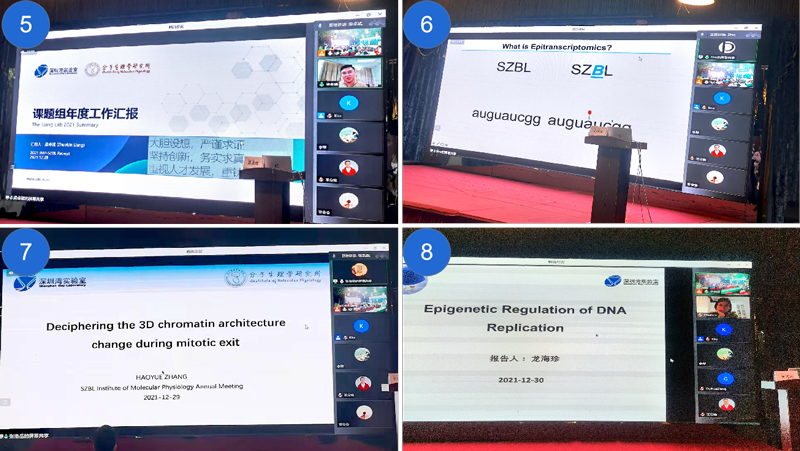
Figures 5~8 Reports by Liang Zhuobin's Research Team, Wu Weixiang's Research Team, Zhang Haoyue's Research Team and Long Haizhen's Research Team
principal investigators, Liang Zhuobin, Wu Weixiang and Zhang Haoyue, gave working reports online respectively. Liang Zhuobin said that his research team mainly carried out the researches on the mechanism of genome instability and new genome editing engineering technology. He introduced in detail the working progress from basic medical research to precision medical technology development carried out by his research team based on the cutting-edge synthetic biology technology.
Wu Weixiang introduced that the original function of modified RNA might be changed, but the original gene sequence would not be altered, so it was hard to be identified. Therefore, his team carried out research on the development of new transcriptomic technology (nanopore direct RNA sequencing). His team has developed x-Pore software now to effectively screen out relevant information containing RNA modifications. The achievement has been published on Nature Biotechnology.
Zhang Haoyue introduced the research on the dynamic changing process of 3D chromatin architecture during the mitotic exit in the past year. His team used the mouse erythroblasts as the model to analyze the role of CTCF during the 3D chromatin architecture remodeling after mitosis. The relevant achievement has been published on Nature Communications.
In addition, the new principal investigator, Long Haizhen, also introduced online the progress of his research on epigenetic regulation of DNA replication in the past six months. Based on the previous researches, the team has further improved the role of histone variant H2AZ in DNA replication. They will continue to study the epigenetic regulation of DNA replication in the future.
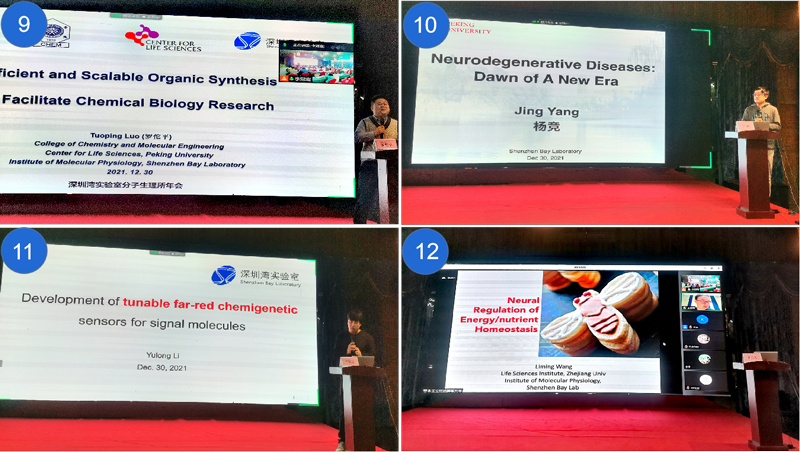
Figures 9~12 Reports by Luo Tuoping's Research Team, Yang Jing's Research Team, Li Yulong's Research Team and Wang Liming's Research Team
Cooperating research fellows, Luo Tuoping, Yang Jing, Li Yulong and Wang Liming, reported the achievements of their research teams in the past years. Luo Tuoping reported the research of his team on the chemical synthesis of natural organic small molecules and relevant derivatives, as well as the precise regulation and mechanism of specific biological processes. Meanwhile, he also introduced the research progress in the screening of specific biological functions of small molecules and the construction process of small molecules screening with specific biological functions. He also introduced the construction process of small molecule platform in the Institute of Molecular Physiology.
Yang Jing introduced the breakthroughs his team achieved recently in the direction of neurodegenerative diseases. The result by the team published onNature in 2020 reveals for the first time the key connection between the core SARM1 signaling of neurodegenerative diseases and the metabolic coenzyme NAD+. It also elaborates the molecular mechanism of NAD+ regulation on Sarm1 protein function and provides a new and precise target for drug development of Sarm1 protein.
Li Yulong introduced the research on tunable far-red chemigenetic sensors for signal molecules. The research team has developed near-infrared chemigenetic probes for a variety of signaling molecules (such as norepinephrine, ATP, cAMP, etc.). The probe is capable of tunable emission wavelength and high signal-to-noise ratio, so it’s prone to be used in combination with other green and red fluorescent probes. The research is greatly significant for the study of complex signaling channels.
Wang Liming introduced the research progress of his team on the neutral regulation of energy and nutrient homeostasis, including a series of changes of nervous system occurred under environmental stress such as sleep insufficiency, hunger, high-sugar and high-fat diet.
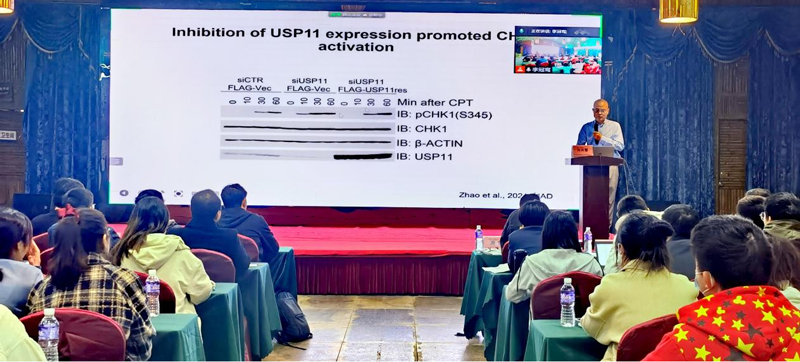
In addition, Professor Xu Xingzhi, Vice Director of the Medical Department of Shenzhen University, was specially invited to make a keynote speech at the conference with the theme “Ubiquitination of CLASPIN regulates the ATR-CHK1 checkpoint pathway”. He introduced in detail the regulation of protein post-translational modification, especially ubiquitination, in the process of DNA replication and replication stress; he also shared the experience of his team in the field of DNA damage repair, which provided the ideas for other relevant research teams and researchers of the Institute. The wonderful speech by Professor Xu has not only enriched the contents of the annual conference, but also effectively promoted the exchanges and cooperation between the Institute of Molecular Physiology and the external organizations.
On December 30, Senior Principal Investigator, Yan Zhiqiang, delivered the closing speech. On behalf of the Institute of Molecular Physiology, he expressed the gratitude to all the cooperating research fellows for their great contribution in the early stage of construction in 2019. Meanwhile, he also sincerely thanked the Shenzhen Bay Laboratory for its full support to the Institute in all aspects. He recalled that the Shenzhen Municipal Government built the Shenzhen Bay Laboratory with the original intention to make up for the shortboards of biomedical researches and transformations in Shenzhen. As a new scientific research institution with both opportunities and challenges, Shenzhen Bay Laboratory has received high expectations and strong supports from the local government, so we should cherish the chances more and bravely face the challenges, and strive to carry out the scientific researches well towards the goals.