Recently, SZBL led a mass spectrometry seminar which invited six prominent spectrometrists to exchange and share their experience and cutting-edge expertise on large molecules and proteomics analysis.The seminar, also delivered through the form of webinar, welcomed a total of over 200 participants from universities, research institutes, pharmaceutical enterprises and institutional investors.

In view of challenges in the determination of physical and chemical properties of intact protein and protein complexes, Wang Guanbo, Professor of Nanjing Normal University and also researcher at SZBL, introduced a mass spectrometry-based strategy that can be applied in the dynamics analysis on molecular weights and higher-order structures of glycoproteins and complexes.

Dong Mengqiu, an investigator from the National Institute of Biological Sciences (NIBS) who has made breakthrough researches in developing cross-linking mass spectrometry, introduced her research on applying cleavable cross-linker, DSSO and uncleavable cross-linker, DSS on peptide sequencing and data analysis, which provides reliable basis for the selection of cross-linkers.

Themed on the development of integrative structural mass spectrometry for structural biology, Li Huilin, Professor at Sun Yat-Sen University School of Pharmaceutical Sciences, introduced three mass spectrometry-based approaches for analysing protein complexes, including native top down protein analysis, cross-linking mass spectrometry, and hydrogen-deuterium exchange mass spectrometry. Innovative research progress on MS analysis of protein complexes has been achieved.

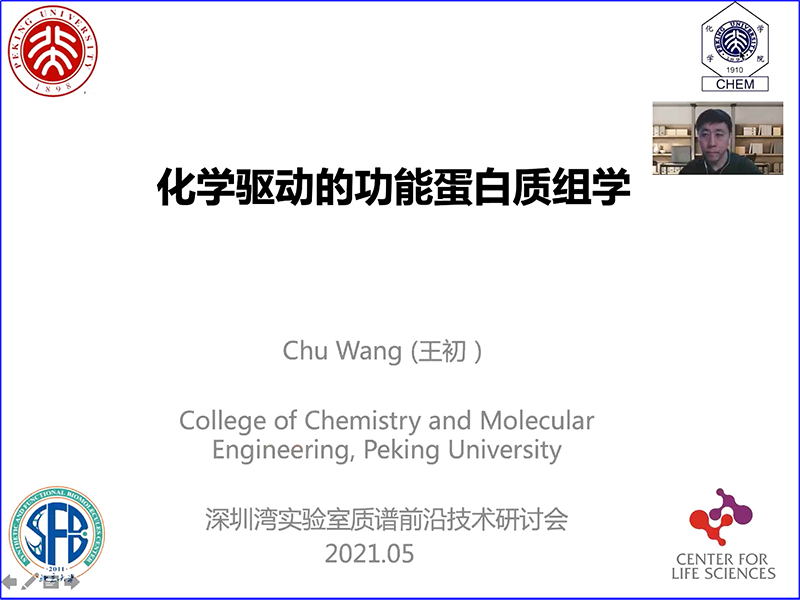
Wang Chu, Professor at Peking University, College of Chemistry and Molecular Engineering, has been focusing on targeted proteomics, post-translational modifications, and active centres of enzymes. He introduced the application of chemical probes in the research of itaconic acid post-translational modification proteomes.
Liu Xiaoyun, Assistant Professor at Peking University College of Basic Medical Sciences has been studying mass spectrometry-based proteomics and bacterial pathogenesis, especially with the host-pathogen interactions. He talked on the challenges facing type III effector protein research and introduced methods for screening protease substrate through quantitative modification proteomics.

Professor Peter B. O’Connor from the University of Warwick delivered the talk via live video. Based on multidimensional mass spectrometry, he shared a new approach to analyse biomolecules. In view of the resolution limit in the separation of parent ions in quadrupoles, Professor O’Connor put forward a two-dimensional analysis strategy that controls the trajectory of ion in the mass spectrometer, which overcome the limit of separation resolution in quadrupoles. This strategy can achieve one-off data acquisition in complex biological samples and will offer more possibilities for multi-omics researches.

A panel discussion was also scheduled after the individual reports to focus on the applications of basic and biomedical research using mass spectrometry. Invited speakers shared research challenges and outlooks in the discussion and exchanged on trans-disciplinary cooperation in mass spectrometry.

(From left to right: Wang Guanbo, Liu Xiaoyun, Li Huilin, Li Gang and Huang Min)
Also attended the seminar were SZBL PIs including Zhou Yaoqi, Peng Qin, Li Gang, Tsai Yu-Hsuan and Deng Lin, as well as technicians from SZBL subordinate institutes. The day-long seminar has promoted the influence of the Mass Spectrometry Core at SZBL, with the overall aim as one of the move to create more innovative vitality and scientific attraction for the Guangming Science City.