The Third Guangdong-Hong Kong-Macao Greater Bay Area (GBA) Workshop on Cutting-Edge Optical Microscopy Imaging Techniques, hosted by the Bioimaging Platform of the Biomedical Experimental Technology Center at Shenzhen Bay Laboratory, concluded successfully from January 5 to 8, 2026. The workshop featured 17 scientists and 9 senior technical experts in domestic microscopy imaging delivering on-site lectures. It attracted over 30 research personnel from more than 20 domestic and international institutions, including Peking University, The University of Queensland (Australia), Fudan University, Tsinghua Shenzhen International Graduate School, Peking University Shenzhen Graduate School, National University of Defense Technology, Shenzhen University, Southern University of Science and Technology, Sichuan Agricultural University, Chongqing Medical University, and the Changchun Institute of Applied Chemistry, Chinese Academy of Sciences. Additionally, numerous faculty and students from within the institution actively participated, filling the conference room to capacity. The session featured frequent on-site interactions and a vibrant atmosphere of discussion.
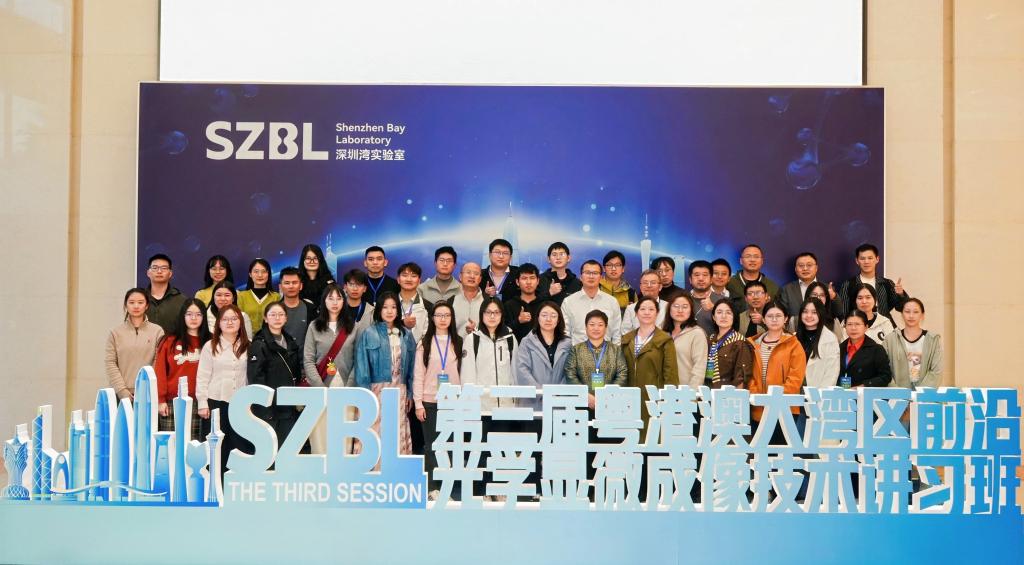
The workshop curriculum spanned multiple specialized domains, including microscopy fundamentals, confocal imaging, two-photon imaging, SIM, STROM, light-sheet microscopy, label-free imaging, nonlinear Raman imaging, tissue clearing and preparation, and expansion microscopy. Built upon a solid theoretical foundation, the courses deeply dissected the core logic of cutting-edge applications. Combined with hands-on training sessions, they formed a complete teaching loop progressing from theory to application to practice, earning unanimous high praise and enthusiastic commendation from participants.
The workshop also featured 28 specialized technical training sessions covering point-scanning confocal imaging, structured illumination microscopy for super-resolution, single-molecule localization for super-resolution, two-photon microscopy, light sheet microscopy, high-content imaging, fluorescence resonance energy transfer (FRET), and TIRF+FLIM+FCS techniques.
The successful convening of this workshop not only established a cross-disciplinary exchange platform for professionals in biomedicine, optical engineering, and related fields, but also deepened participants' systematic understanding of advanced optical imaging technologies, core instrument principles, and cutting-edge applications. It further facilitated profound exchanges of innovative ideas and efficient sharing of high-quality technical expertise, laying a solid foundation for cultivating high-caliber professionals with both theoretical knowledge and practical skills, and for jointly advancing the coordinated development of the high-end optical instrument industry.