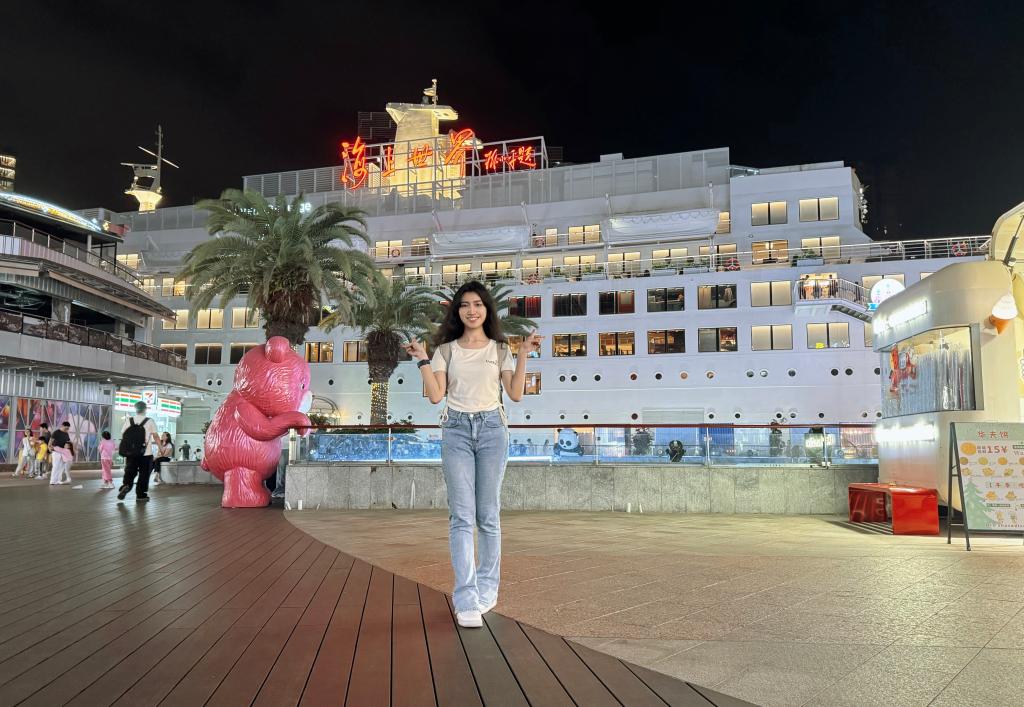
For 24-year-old Malaysian girl Lee Hsuan Suan, her initial impression of the word “Shenzhen” was a drone descending from the sky.
It was an evening shortly after she arrived at the Shenzhen Medical Academy of Research and Translation (SMART). She stood downstairs by her dormitory, watching a drone slowly fly in from a distance, descend precisely at the designated spot, and steadily deliver a takeout order.
The entire process took no more than a few minutes.
But she stared at that drone for a long time.
Later, recalling that moment, she would always smile and say:
“At that time, I only had one thought in my mind—this is very Shenzhen.”
Before coming to Shenzhen, Lee Hsuan Suan had already lived in China for three years.
During her undergraduate studies at Tianjin University, she had long adapted to the Chinese-language environment. However, Shenzhen gave her a completely different feeling.
It did not come from the skyscrapers, nor from the buzzwords in city promotional videos.
Rather, it came from specific, vivid details:
Drone food deliveries, innovative scenarios spread across the city, people from different backgrounds gathering together for the same dream... That “sense of the future”, which once only existed in the news, has become an everyday reality in Shenzhen.
And she gradually realized that she came here not just to pursue a Ph.D.
Why come to SMART?
Lee Hsuan Suan’s mother tongue is Chinese, and she attended National-type Chinese primary and secondary schools in Malaysia since childhood.
After graduating from high school, she came to China to complete her undergraduate studies at Tianjin University.
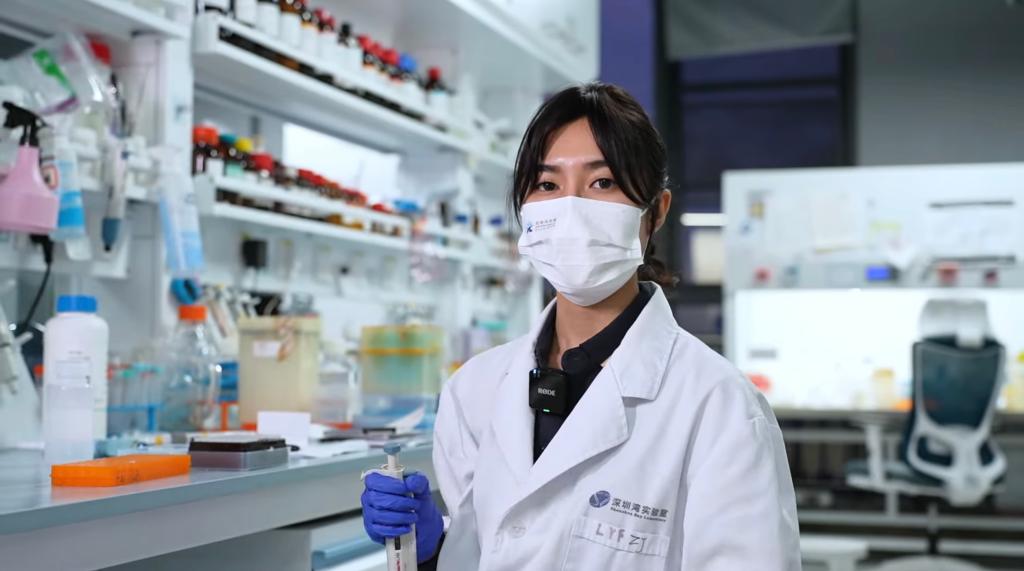
During her undergraduate years, she was primarily engaged in research related to hypoxic tumor nanodrug delivery.
That was her first time truly entering the world of scientific research—experiments, data, literature, and discussions.
The appeal of scientific research to her came not only from the process of discovering answers but even more from the process of constantly asking questions.
As her research deepened, she gradually realized a problem:
In the future, many important medical problems will be difficult to solve relying solely on a single discipline.
Cancer treatment requires chemistry, biology, and clinical medicine, as well as engineering technology.
More and more breakthrough achievements are happening at the intersecting boundaries of disciplines.
When she decided to pursue a doctoral degree, she began looking for a platform that could truly promote interdisciplinary integration.
It was then that she learned about SMART.
This young scientific research institution left a deep impression on her:
It gathers scientific research talents from all over the world
It encourages in-depth cooperation between different disciplines
It focuses not only on basic science but also on future clinical applications and the translation of achievements
It attempts to build a brand-new scientific research ecology
“I hope my research can advance further towards more cutting-edge interdisciplinary directions.”
Thus, she traveled from Tianjin to Shenzhen, becoming a second-cohort Ph.D. student in the joint training program between SMART and Tsinghua University.
From “Completing Tasks” to “Understanding Problems”
Lee Hsuan Suan’s supervisor, Dr. Tsai Yu-Hsuan, is from Taiwan, China.
During her first group meeting, she prepared very meticulously: the experimental results were organized, and the literature had been read in advance.
However, compared to the experimental results themselves, her supervisor paid more attention to the scientific questions behind these results:
“What is the logic behind this design?”
“Why is this strategy worth pursuing?”
“What if we approach it from a different perspective?”
These questions kept coming up.
At first, she was somewhat unaccustomed to it. In her past learning experiences, she was more used to accepting and completing tasks.
But her supervisor seemed to care more about another thing:
Why?
Later, she gradually discovered that what Dr. Tsai Yu-Hsuan truly wanted to cultivate was not experimental skills, but the ability to think independently.
Sometimes, when experimental results were less than ideal, the supervisor would not focus on the outcome first, but would press further:
“What did you learn from this failure?”
This training method gradually changed her understanding of scientific research—
Research is not about finding standard answers, but about continuously approaching the essence of the problem.
Shifting from focusing on experimental results to constantly questioning the logic behind the problems signified not only a change in research methodology but also the growth of a scientific research mindset.
A Scientific World Within One Building
Since arriving at SMART, one of Lee Hsuan Suan’s most profound feelings is the omnipresent “connection” here.
This connection is first reflected among disciplines.
Going from the first floor to the twentieth floor takes merely dozens of seconds.
But every time the elevator doors open, behind them lies a different research direction:
Structural biology, chemical biology, immunology, neuroscience, translational medicine...
For the first time, she intuitively saw the complete biomedical research chain:
Basic research poses questions
Technology platforms provide tools
Clinical needs feedback directions
Industry drives the translation of achievements
Fields that previously seemed independent of each other are tightly connected here.
This feeling is especially apparent when participating in academic events hosted by SMART.
At the “Third Bay Area Molecular Interaction Detection Technology Symposium”, she listened to scientists share cutting-edge research such as tumor immunotherapy, while simultaneously watching real-time demonstrations of the latest instrument platforms.
The distance between theory and practice was significantly shortened.
“Often, scientific research is not just about doing experiments”, she said. “What is more important is how to utilize methods from different fields to solve truly important problems.”
And SMART is continuously creating such opportunities.
Science Connects the World
This year, the APEC meeting will be held in Shenzhen.
As a young scientific researcher from Malaysia, Lee Hsuan Suan pays special attention to this.
In her view, her own growth experience is a microcosm of international exchange:
From Malaysia to China, from Tianjin to Shenzhen, from an undergraduate to a doctoral student.
Along the way, she has increasingly felt the immense significance of cross-cultural exchange in scientific research.
“Science itself has no borders,” she said. “But different countries will have different research cultures and ways of thinking.”
Such differences do not form obstacles. On the contrary, they often bring new perspectives and new possibilities.
She often thinks about Malaysia’s rich natural product resources, while also paying attention to China’s development in fields like artificial intelligence-assisted drug screening and biomedical innovation.
From her perspective, there is vast room for collaboration between the two.
And platforms like APEC are making such collaboration increasingly possible.
Seeing the Future in Shenzhen
What are her plans after graduating with her Ph.D.?
Facing this question, Lee Hsuan Suan hardly hesitated.
“I hope to continue deepening my involvement in the field of interdisciplinary biomedical research in the future, and I will also prioritize development opportunities in Shenzhen and the Guangdong-Hong Kong-Macao Greater Bay Area.”
This answer was not a sudden decision made one day.
Rather, it was slowly formed through countless research discussions, academic exchanges, and moments of witnessing innovation happen.
Shenzhen made her see that scientific research does not only happen in the laboratory.
It can also connect hospitals, connect enterprises, connect clinical practice, and connect the world.
Many years ago, she set off from Malaysia.
At that time, she did not know where her future would lie.
Today, however, she is becoming increasingly clear about the scientific research path she wants to take.
For this young student from Malaysia, Shenzhen is no longer just the next stop in her academic journey.
It has also allowed her to see more possibilities for the future development of scientific research.