Highlight
A research work by Prof. Jing Yang's group in the Institute of Molecular Physiology at the Shenzhen Bay Laboratory (SZBL) was published in Science Advances. In the paper entitled "Local Sympathetic Innervations Modulate the Lung Innate Immune Responses", the novel function of local sympathetic innervations was reported for the neuroimmune regulation in the lung.
About the Research
Due to its direct exposure to the outer environment, the lung is continuously challenged by pathogenic infections. As a result, immune response in the lung must be under tight and stringent control. The new study by Prof. Jing Yang's group has revealed the neurophysiological mechanism underlying the immunomodulation afforded by the local sympathetic signal in the lung.
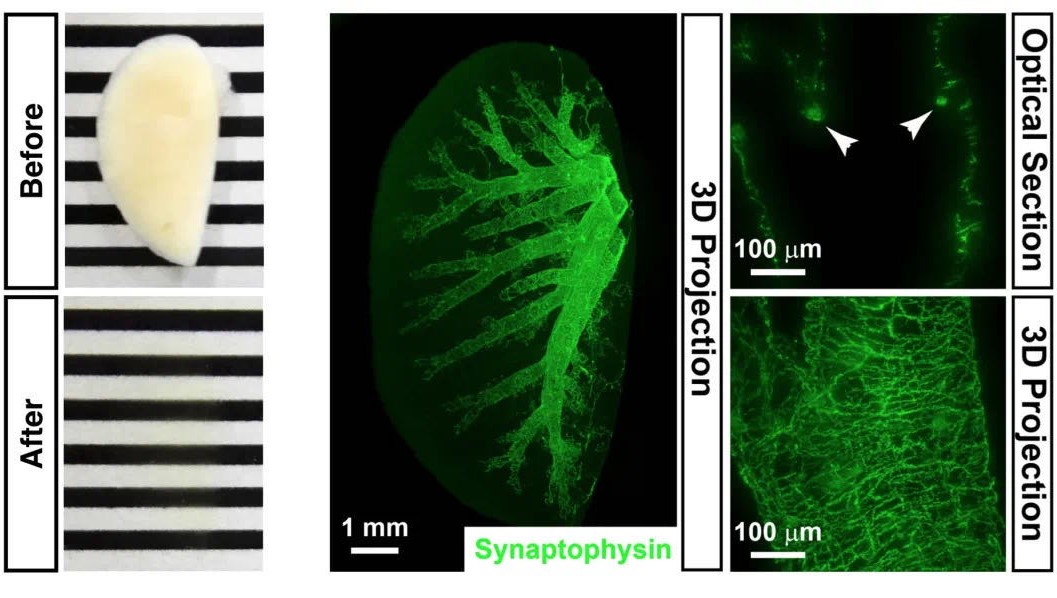
In this important work, an advanced imaging technique, named iDISCO(ace), was firstly established, which enabled the whole-tissue immunolabeling and 3D fluorescence imaging of the unsectioned lung tissues. Notably, though several 3D imaging methods were previously developed, these existing methods are often incompatible with immune cell-related epitopes, which limits their utilization in many scenarios. In contrast, the new iDISCO(ace) technique has effectively overcome this common challenge encountered in the field and offered the robust 3D assessment of neural innervations and immune cells in the lung.
Further, Prof. Jing Yang's group demonstrated that two critical types of innate immunity in the lung, i.e., antibacterial immune response or type 2 immune response, are both negatively controlled by local sympathetic innervations and its downstream adrenergic signal. In particular, ablation of the sympathetic innervations significantly enhanced these two types of immune responses. Moreover, the sympathetic neurotransmitter norepinephrine could act on the b2-adrenergic receptor expressed by immune cells, and thereby, directly exert the immunomodulatory effects. Accordingly, administration of the specific agonists for the b2-adrenergic receptor was sufficient to suppress antibacterial or type 2 innate immune response. These findings together have advanced the in-depth knowledge of neuroimmune interactions in our body.