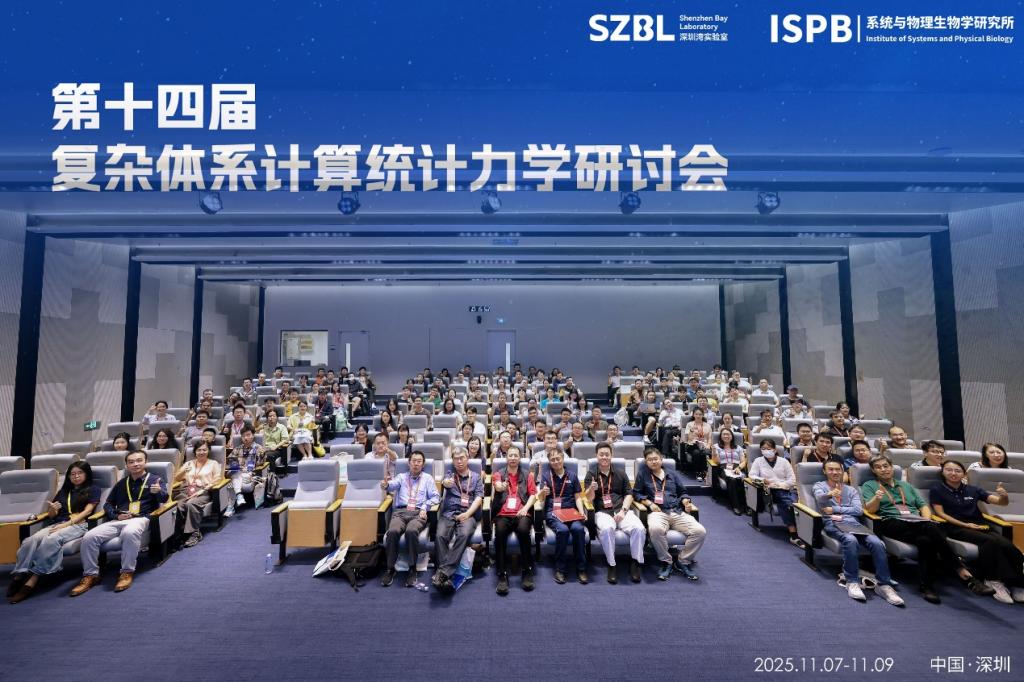
The 14th Symposium on Computational Statistical Mechanics for Complex Systems was successfully held in Guangming, Shenzhen from November 7 to 9, 2025. The event was jointly initiated and organized by Junior Principal Investigators Yi Yang, Yangyi Lu, and Kai Huang from the Institute of Systems and Physical Biology, Shenzhen Bay Laboratory(SZBL).
Since its inception in 2011, the “Computational Statistical Mechanics Symposium on Complex Systems” has evolved into one of the most influential academic brands in China's computational science field. The conference consistently upholds interdisciplinary exchange as its core purpose, with a mission to foster cross-disciplinary collaboration and nurture young scholars. It is dedicated to providing a high-level academic platform for researchers in computational statistical mechanics. Past conferences have focused on cutting-edge interdisciplinary topics, covering core areas such as classical and quantum dynamics, statistical physics, molecular simulations, materials and biological simulations, while progressively expanding into emerging fields like machine learning, multiscale biological simulations, and topological quantum materials. Hosted by over ten domestic universities and research institutions across multiple cities nationwide, the conference has fostered an extensive academic collaboration network.
On the morning of November 8, the14th Symposium on Computational Statistical Mechanics for Complex Systemscommenced with a welcoming address bySenior Principal InvestigatorJialiGaofrom the Institute of SystemsandPhysicalBiology, SZBL, representing the host institution. Over fifty leading scholars from more than thirty domestic and international universities and research institutions gathered in Shenzhen to explore theoretical breakthroughs and technological innovations in complex systems research, contributing to the development of the Guangdong-Hong Kong-Macao Greater Bay Area as a hub for scientific and technological innovation.
The successful convening of this conference was made possible by the dedicated hardware and technical support from multiple research institutions and enterprises. This signifies the deep integration of China's computing power ecosystem with research applications, heralding the potential for leapfrog development in computational statistical mechanics research for complex systems based on indigenous technological foundations.
At the closing ceremony, ProfessorQiangShi from theInstitute of Chemistry Chinese Academy of Sciences, delivered a speech, marking the successful conclusion of this conference. As a pivotal bridge between past and future, the meeting formally confirmed that the 15th conference will be hosted by Fudan University in Shanghai in 2026. The torch of academic excellence continues to be passed on—let us look forward to our rendezvous in Shanghai in 2026!
This symposium not only comprehensively showcased the latest advancements and future directions in computational statistical mechanics for complex systems but also successfully established a high-level international exchange platform for young talents, fostering collaborative intentions among multiple research teams. The conference earned unanimous praise from global experts for its exceptional depth of exchange. Attendees noted that while the research path in computational statistical mechanics for complex systems remains long, sustained global scientific efforts and collaborative innovation will undoubtedly bring new hope to patients worldwide.